

Europe's Rail Market Gets Its Ryanair Moment
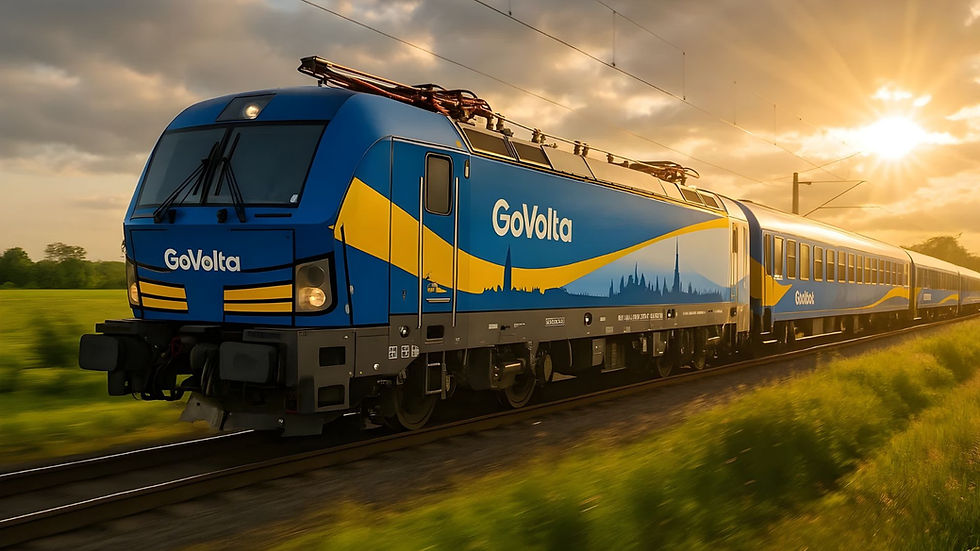
A Dutch startup is betting that cheap tickets and guaranteed seats can do to trains what budget airlines did to flying.
GoVolta, a privately held rail operator founded in Breda, launched its first international services from Amsterdam to Berlin and Hamburg on 19 and 20 March respectively, entering a market long dominated by state-backed incumbents and pitching itself as the first genuinely low-cost alternative to both the plane and the car on the North Sea-to-Germany corridor.
Tickets on the newly launched routes start at €19 one-way, undercutting Deutsche Bahn's ICE fares, which currently range between €34 and €59 on the same routes, with up to four changes required and seat reservations costing an additional €5.70. The trade-off is speed: GoVolta's rolling stock travels at a maximum of 160 km/h, making the Amsterdam-Berlin journey roughly an hour longer than Deutsche Bahn's equivalent service.
The model borrows liberally from the airline playbook. Each train runs 11 carriages with around 820 seats, includes a lounge car, and guarantees passengers a reserved seat, a pointed contrast to the standing-room conditions that have become shorthand for European rail's image problem. City-break packages bundling train tickets and hotel bookings are also available at launch.
Both routes will initially run several times per week before ramping up to daily departures during the 2026 summer season. An Amsterdam-Paris service is planned for December, with longer-term ambitions including Frankfurt, Munich, Copenhagen, Bruges and Basel.
The regulatory backdrop is not entirely straightforward. GoVolta is restricted under Dutch cabotage laws from carrying domestic passengers, a constraint currently the subject of proceedings at the European Court of Justice.
The structural tailwinds, however, are considerable. Liberalisation of long-distance passenger markets across several EU member states has opened the door for new entrants to compete on key international axes, and with European policy firmly oriented toward modal shift away from aviation, GoVolta's timing may prove shrewd.


Comments